Schedule 1-A (Form 1040) is the additional deductions schedule created for the One Big Beautiful Bill Act deductions. Every new deduction is worked out in its own part of this one form, and the total flows to your Form 1040. This guide goes part by part, in the form’s own order.
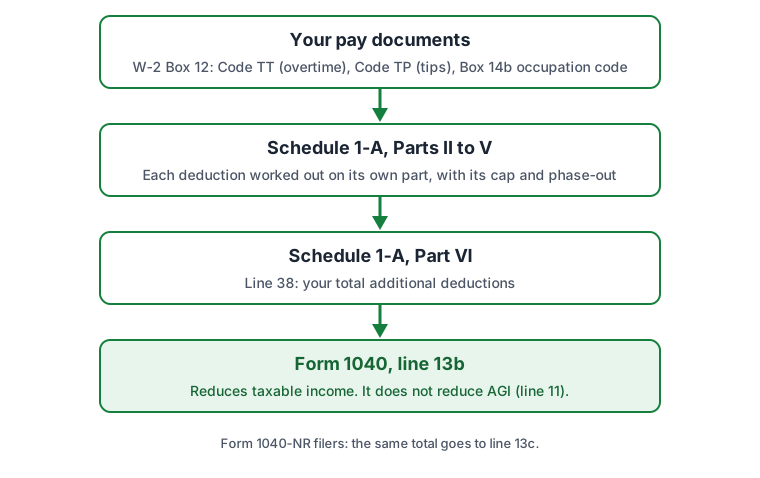
The whole claim in one picture: documents in, one total out, onto line 13b of the 1040.
Part I: modified adjusted gross income
Part I works out your MAGI, the income figure every phase-out on the form uses. It starts from your adjusted gross income and adds back certain foreign income amounts. Most US workers with no foreign income will find their MAGI equals their AGI, but the form makes you compute it, because each deduction’s phase-out is measured against it.
Part II: tips (lines 4 to 14)
Part II takes your qualified tips from the reporting forms: W-2 box 7 or Form 4137 for employees, or 1099-NEC box 1, 1099-MISC box 3 or 1099-K box 1a for tips received in a trade or business, capped at that business’s net profit. It applies the $25,000 cap and then the phase-out: subtract $150,000 ($300,000 joint) from MAGI, divide by 1,000 dropping the fraction, multiply by $100, and subtract. Our tips calculator runs exactly these lines.
Part III: overtime (lines 15 to 21)
Part III starts with the qualified overtime compensation figure. For 2026 onwards that is the Box 12 code TT amount from your W-2 (or the rare 1099 equivalents); see code TT reconciliation if it does not match your pay. It applies the $12,500 cap ($25,000 joint) and the same round-down phase-out maths as Part II. Our overtime calculator mirrors it.
Part IV: car loan interest (lines 22 to 30)
Part IV is a small worksheet of its own. For each vehicle you list the VIN, the interest paid, and any of that interest already deducted on Schedule C, E or F. The deductible column is capped at $10,000 in total, and the phase-out here is different: the excess over $100,000 ($200,000 joint) is rounded UP to the next whole $1,000 before multiplying by $200. That one word, rounding up instead of down, is why this deduction vanishes fastest. Our car loan checker follows the same lines.
Parts V and VI: seniors, then the total
Part V covers the additional amount for seniors, the one deduction on this form this site does not calculate. Part VI adds the parts together and sends the total to Form 1040 line 13b (line 13c on Form 1040-NR). That line sits below the AGI line, which settles a common question: these deductions reduce your taxable income, not your adjusted gross income.
Before you file
Work each part with its calculator first, then check the totals against the form. If a W-2 figure and your own records disagree, the reporting rules decide which number you may use, and for overtime from 2026 that is the code TT amount unless your employer issues a W-2c.