The headline version of this deduction, “no tax on overtime”, overpromises. The law (section 225) deducts only the premium: the amount paid above your regular rate for overtime hours the Fair Labor Standards Act requires. Understanding that one sentence is the difference between a correct claim and an inflated one.
Only the premium counts
If you earn $30 an hour and work an overtime hour at time and a half, you are paid $45. The deductible part is $15, the half above your regular rate. The other $30 is ordinary pay for that hour and is taxed as always. Across a year this is why the deductible figure is roughly a third of your total overtime pay at time and a half, a pattern you can test in the overtime calculator: $30 an hour and 200 overtime hours produces $9,000 of overtime pay and a $3,000 deduction.
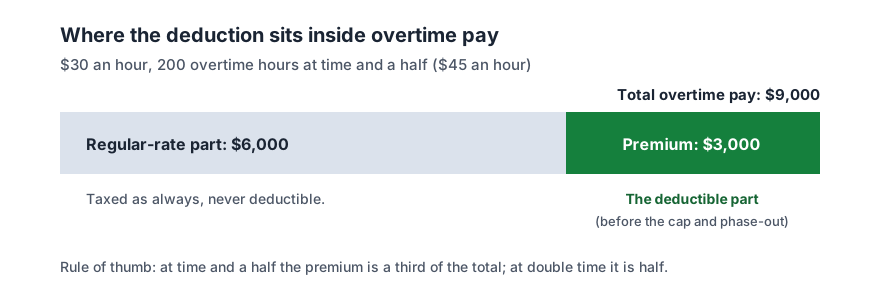
The same $9,000, split the way the law splits it.
It has to be FLSA overtime
Only the premium for overtime required under FLSA section 7 counts: broadly, hours over 40 in a workweek for non-exempt employees, at a regular rate the FLSA recognises. Extra pay that exists only because of state law, a collective bargaining agreement or your employer’s own policy does not qualify beyond the FLSA-required amount. If your employer pays double time where the FLSA requires only time and a half, the deductible part is still built on the FLSA premium alone. Employees who are exempt from FLSA overtime do not earn qualified overtime compensation at all.
How your employer works it out
Employers compute the reportable premium as FLSA overtime hours multiplied by one half of the FLSA regular rate (IRS FS-2026-13, Q12). From 2026 they must report it on your W-2 in Box 12, code TT, and that reported figure is the basis of your claim; the reconciliation tool covers what happens when it looks wrong.
Caps, phase-out and filing rules
The premium is capped at $12,500, or $25,000 on a joint return. Above $150,000 of MAGI ($300,000 joint), the deduction falls by $100 for every full $1,000 over the threshold, so it is fully phased out at $275,000 ($550,000 joint) for someone at the cap. If you are married, you must file jointly to claim it. The deduction runs for tax years 2025 to 2028 and reduces taxable income, not AGI.
For the side-by-side table of every cap and threshold, see the caps and phase-outs reference.
The three mistakes to avoid
Claiming the whole overtime amount instead of the premium. Counting voluntary or contract-only overtime premiums the FLSA does not require. And, from 2026, claiming an amount your W-2 does not report in code TT because your own records are higher: without a W-2c from your employer, the reported figure is the ceiling.